Sunday, December 09, 2007

Star in the East


I’ve been following the news of Comet Holmes, which erupted into view several weeks ago. It had been a humdrum comet, barely visible, but then suddenly astronomers were bragging about how big it was, and how bright.

I’ve been itching to get a glimpse of it myself. Sadly, it didn’t spark into bright view until it was already on its retreat from the sun. Normally you get a chance to see a comet on its way in, then again on its way back out to the nether reaches of the solar system.

You get rain; you get clouds; you get bright city-lit nights. Now and then you get a chance to have a good look at the sky on a clear night when there aren’t too many lights around.

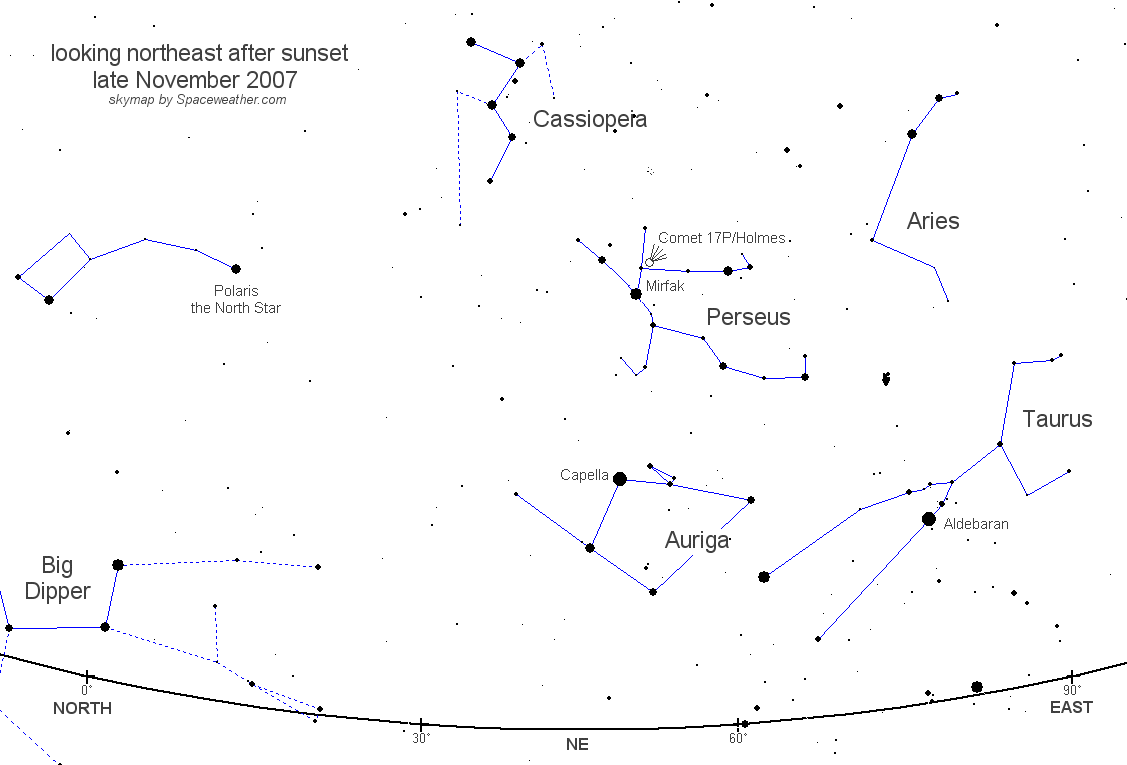
But from tonight’s observations, I’d have to say the comet is gone from easy view. Here’s a link to help you see where you’re supposed to be able to spot the comet in the night sky.

And here’s a picture from tonight, that shows Cassiopeia and Perseus. They’re inverted from their positions in the star chart at the previous link, because the picture was shown taken later at night. I have marked the basic lines linking the stars.


The comet is supposed to be roughly at the spot where the three legs of the Perseus “wishbone” come together. The picture above (a 4-second exposure) shows no comet, even when I dial up the brightness on everything in the sky.


You can see some other stuff in the general vicinity, including a few dim stars that show up on star charts. And one of the slightly lighter-colored lumps of protoplasm may well be the comet. But if it is, it’s hard to differentiate from the background, and it’s definitely not a dominant bright mark in the sky, as it was a month ago.

So it looks as if I missed my chance to catch the comet. On the positive side, I’m very pleased with how well this camera takes pictures of stars. I may have to try this more often.


My buddy Orion

The Star-Splitter
by Robert Frost

You know Orion always comes up sideways.
Throwing a leg up over our fence of mountains,
And rising on his hands, he looks in on me
Busy outdoors by lantern-light with something
I should have done by daylight, and indeed,
After the ground is frozen, I should have done
Before it froze, and a gust flings a handful
Of waste leaves at my smoky lantern chimney
To make fun of my way of doing things,
Or else fun of Orion's having caught me.
Has a man, I should like to ask, no rights
These forces are obliged to pay respect to?"
So Brad McLaughlin mingled reckless talk
Of heavenly stars with hugger-mugger farming,
Till having failed at hugger-mugger farming,
He burned his house down for the fire insurance
And spent the proceeds on a telescope
To satisfy a life-long curiosity
About our place among the infinities.

--first stanza
from Astronomy a Go Go

Saturday, December 08, 2007

Don’t Call It Frisco


Moscone West looks as if it was designed by Steve Jobs: All white, no distinguishing features, translucent.


Saturday, December 01, 2007

Recognition

I have been dabbling in Irving Stone’s 1934 biography of Vincent Van Gogh, Lust for Life. Forty-four years after Van Gogh died, Stone was writing closer to the artist’s time than to ours; it would be something like me writing about Buddy Holly.

Stone includes no dates in his story; he tells it as a novel. At a certain point to keep my mind straight I found on the Web a timeline of Van Gogh’s life and printed it. In a bookstore over Thanksgiving (the old New Varsity for those who know it), shopping for music, I found something better: a boxed kit of Van Gogh paraphernalia—masks, stickers, tattoos, postcards—that included a CD with 186 of his drawings and paintings. Not everything he ever did, but a rich trove.

Decades ago, in a magazine ad for maybe a PBS show, I vividly remember seeing a collection of about a dozen of Van Gogh’s self-portraits, showing the progress of his artistic style as his genius exploded. Just the sequence of self-images spoke volumes about his state of mind. Staid browns give way to trembling pastels; the beard and ear bandage come and go; backgrounds go from flat to swirling whorls of rich color. The collection stuck in my mind, but I’d never seen it recompiled.

I was delighted to find I now had the tools to re-create the sequence:
It’s hard to read a novel about an artist without seeing the art. I can only imagine the effort Stone had to make to see a lot of Van Gogh’s pieces, scattered through collections across several continents, to get a feel for the flavor of the artist from different periods. An image on a screen isn’t the real thing, but I’m spoiled by the tools I have today to slice through the collection.

The text-based facts are easier to come by these days too. It reshapes research.

As I put the sketches, drawings, and paintings in rough order and sift through them, I see Van Gogh struggling to catch in his brush the way light reflects off a barn roof, the dart of a lark out of a cornfield, the lazy swaying of flatboats tied to a river bank, the way a tavern’s lights play off cobblestones in the street outside—the same things a kid with a Canon tries to catch today. Across a century and change, I follow his eye as it marks images he wants to share.

I’m put in mind of a remark I read several years ago, a rapper telling how hip-hop served as a kind of telegraph between communities. He said he could listen to a rapper from a different city, another coast, a far-off country, and through his words he could build an image of what life was like over there—the weather, the cars, the feel of the streets, the rhythm of neighborhood conversation.

Wednesday, October 31, 2007

Another Saturday Night

New theater in town

The joint just opened two weeks ago with a two-week, six-show run by the Eagles and the Dixie Chicks. I made it to the last show of the run. I had never seen either act, and I was looking forward to both.


I showed up very early because I was worried that parking would be hard to come by. So I had lots of time to take pictures before the show. Parking was pretty straightforward and close by . . . at least for people who got there way too early.

The Kings were playing across the way at Staples Center, so the Kobe burger was available.

On nights when the Lakers are playing, the cafe serves the Luc burger.


The Dixie Chicks gave us some songs from their latest album, including “Not Ready to Make Nice” and “The Long Way Around.” From that album, they also dug up “Easy Silence,” which I had never noticed before. It shone in the live performance.

The Chicks put on a short set, with just a little stage patter (“This is the last engagement of our six-show 2007 tour . . . There’s a reason they call us the least hard-working band in show business”), and plenty of material to choose from.

Incidentally, I was pretty pleased with how well my camera did that night. You can click on most of the pictures here to see the level of detail I got from the back rows. To be able to pick up a wedding ring or the tip of a moving performer’s spike heel at that distance has to go beyond anything Ansel Adams ever dreamed would be technically possible.

Not that any of these shots get near his level of artistry, and not that you couldn’t do better (these days) with even fancier equipment. But for a low-end consumer-grade digital point-and-shoot, I was fairly happy with the results.

Of course, it helps when the performers’ rings have such big rocks in ’em.

The Chicks played “Landslide,” “Wide Open Spaces,” “Goodbye, Earl,” “Long Time Gone,” “Sin Wagon,” “Cowboy, Take Me Away,” and a mess of other hits.

I would have loved to hear them do “Traveling Soldier,” but time was short. The audience was pretty clearly glad to welcome them to Los Angeles.

The second band of the night warmed up with four numbers from their new album: “How Long,” “Busy Being Fabulous,” “Guilty of the Crime,” and one other I don’t remember. Joe Walsh’s voice sounded a little weak on “Guilty of the Crime,” but by the time we got into the thick of the evening with tunes like “Life in the Fast Lane,” he had come right up to speed.


First tune up after those four was “Hotel California,” with a long and wonderful trumpet intro.

This would be “In the City.” (Get the backdrop?) We heard a lot of Don Henley solo material, which didn’t bother me at all: “Boys of Summer,” “Dirty Laundry,” and “Sunset Grill” made the cut.

Joe Walsh was the only one that night who broke out of extremely tight versions of album favorites to interact with the crowd. Here he is with his “helmet cam,” which he used to put pictures of front-row audience members on the big screens over the stage.

This is during “Life’s Been Good,” which he freshened up with lines like “I got a limo/ I ride in the back/ I go to Lakers games/ And sit next to Jack.” The crowd ate it up. (Another: “I’m makin’ records/ My fans, they can’t wait/ They write me letters/ And tell me Don’s great.”)

Also during this song, at the lines “He’s cool” and “Oh, yeah,” the words flashed up big on the screen over the stage, for all of us to sing along. Joe knows how to ham it up.

I won’t swear what else was in the set list. No Glen Frey solo stuff. “Desperado” made a fine encore. “Witchy Woman,” “Lyin’ Eyes,” “Peaceful, Easy Feeling,” “Take It Easy,” “Heartache Tonight.” The band played for two hours. I didn’t take notes.

I had heard the band was also playing “Rocky Mountain Way,” which would have been fun, but it wasn’t in my night’s set. They did, however, dig up some old James Gang material. Half the fun of going to an Eagles show is hearing them play each other’s solo stuff. The horn section laid down an incredibly thick, fat sound.

As I walked back over to the parking garage, I stood at the corner while a Maserati pulled out of the VIP parking. I couldn’t see who was inside, but it looked like about four guys. Probably on their way over to the Sunset Grill.

Monday, October 29, 2007

Orchidopesty

I recently became the keeper of a few orchids. Imagine my thrill when I learned that I, a gardener of dubious merit at best, was about to get to watch them burst into bloom.

Imagine my chagrin when I found that someone else also liked my orchid buds.

I frantically ran to my orchid assembly instructions to see what to do. It named about a half-dozen midges, mites, weevils, roaches, and other pestilential scourges that love nibbling away at tender orchid buds. I studied the situation. I did not see whatever critter was doing the nibbling. At a loss to determine what was doing the drilling, I sprayed the buds with an all-purpose bug-killer. I drenched them well.

That apparently tasted good to the culprit. Every morning I’d wake up and find more damage done.

Finally I busted the midnight snacker. I don’t know where the slug had been hiding during the day (in the loose orchid soil, no doubt), but when I flipped on the light last night I caught it in the act.

I think it’s too late to save the buds.

I hope the slug is a good swimmer. It’s far downstream by now.

Sunday, October 28, 2007

A Hole in One


Flats are normally no big deal when you ride a bike. You ride over a thorn, a piece of glass, a shard of metal, the tire goes soft, you swap inner tubes and ride on.

But I can’t remember ever getting a flat before from such a big tree branch.

Heck, it doesn’t even have a sharp point.

I swapped inner tubes and rode on.

Clearly Now


Plenty of fires are still raging south of here, but one by one by one the firefighters are corralling them.

Yesterday was the first day in more than a week when I could catch a glimpse of the hills of Orange County. To do even that I had to actually get to Orange County; this faintly visible ridge in the distance wasn’t visible from Long Beach (as it would be on a clear day).

We’ve had a few days now of moist, cool air blowing in from over the ocean instead of hot, dry winds from the Great Basin. That makes the firefighters’ job easier. The overcast these days is white instead of yellow, and the sky when it breaks through the clouds is a bluer blue again.

The one person I know who was evacuated from her home in San Diego is back again, with her cats.

With a little luck, the cooler weather will hold and this episode will be put behind us.

Wednesday, October 24, 2007

In the Throat


I have been deliberately slow to post any remarks about the fires we’re having around here this week. I’m fine. The fires are nowhere near me, but they’re all around me, from south to east to north. Their effect on the sky over me is hard to ignore.

But I’m not among the fires; I’m just surrounded by them. The nearest is probably fifty miles away. Except for what I see in the newspapers, I probably notice the effect of only one or two of the many fires all over the Southland. The rest are too far to touch my surroundings at all.

Thousands of people have lost their homes; hundreds of thousands—more than the total population of Long Beach or San Francisco—have had to leave their homes behind while fire crews fight the inferno. The net effect in my life has been to wipe up a tiny layer of ash from my kitchen drainboard.

But a couple of people by now have asked, just checking in to make sure I’m still breathing, I suppose. Yes, there has been a tiny whiff of wood smoke on the air lately. And the sunsets have been rich with color, if too hazy to burst with dramatic shapes.

“True” and “color” are a restless match. Our eyes are marvels, constantly adjusting to catch up with current lighting conditions, trying to represent the world around us in a way our brains can use. To us, a red beach ball looks about the same at night, by day, or under fluorescent lights. Sure, it’s not identical, but we recognize it each time. Cameras generally wallow along hopelessly behind our sophisticated system of visual perception. They usually start by trying to represent what a scene actually looked like.

Take a scene from a beach, a picture taken last Sunday. This is what the camera “saw”:

That’s already a little deceptive, because it’s actually how the camera interpreted the light that came through the lens, based on various settings I have adjusted. I let the camera decide how bright to make the picture overall, but I’ve got it set to skew the colors so they’ll be a tiny bit richer, and a little warmer. So it ingests the light, and then it applies a couple of adjustments before it ever records the scene. Then I get home and apply my fine tuning. Anyhow, what’s above is what came out of the camera, unadjusted.

“White balance” refers to an attempt to make sure that the various primary colors in a picture are equally well represented, ranging from absolute black to absolute white. It’s a dodgy business on a good day, but computers are getting better at guessing what’s right. Above is the same beach scene, using Photoshop’s automatic white balance adjustment. This actually overexaggerated the contrast from what I originally saw (trying to get an absolute black), and it made the shadows more blue than what I remembered.

This is the picture as I posted it on this blog on Sunday. I tried to preserve the relative balance of the tints (not skewing the shadows heavily toward blue), but I did enrich the colors a little, by both brightening the light spots and darkening the shadows. What did I really see, and what did the sand really look like? Those are both good questions. I was comparing what I saw on my (LCD) screen to what I remembered, not to the sand itself. And in the first place, I had never seen the sand itself. I saw the light from the sand through my polarized prescription sunglasses. That changes the color and also tends to boost the contrast (and clarity) of a scene.

Same scene, three different ideas of what it ought to look like. The Photoshop version is probably about what the sand would have looked like if the sky weren’t filled with dust: Photoshop took away the influence of the filtered light coming in through the sky making everything yellow-brown. In this case, that set of shades was the effect I was after, so I opted not to use Photoshop’s interpretation. That doesn’t make my picture accurate, except to say it more accurately shows what I wanted to show.

The New York Times Website has been running an interesting series of articles by Errol Morris lately about the tensions between photographs and truth, illuminated by (and illuminating) a set of photographs from the Crimean War. Morris’s photos are black and white. Color just adds another layer of confusion. Consider the following, and decide which is the true color:

In the veneer warehouse at work, we have green-tinted skylights. Plenty of light gets through, so you can see what you’re doing, but it’s all green. Most cameras represent scenes in the building with a green tint. When you’re walking around in the building, though, your eyes tend to adjust the green, automatically white-balancing everything, so you see an object’s colors fairly accurately, just as if you were in broad daylight.

Above on the left you see what the camera picked up with my usual default settings. On the right is the same scene, but with the camera set to adjust the white balance. I didn’t do anything fancy—I just let the camera make its own adjustment. But now take a look at what the home computer does:

Here I have used Photoshop to automatically white-balance each of the original shots, using its algorithms. See how much warmer the original shot comes out? That’s probably the way you’d want the wood to look in a final reproduction. Compared to this, the camera’s automatic white balance has rebalanced the shot to avoid green, but in the process it has ended up looking washed out. Part of this is a matter of taste. With wood, it’s actually important to give a customer a realistic representation of what the end product will look like—shade, grain, contrast. (Not all wood is the same shade of brown.)

It never surprises me when a full-blown computer with all the time in the world does a better job of enhancing a photo than a digital camera can do on the fly under adverse conditions.

So I could post more pictures of what the sky looked like today, but I’m naturally reluctant to give the wrong impression, whether it came from the camera itself or from postproduction.

As Laurie Anderson pointed out, “It’s a sky-blue sky.” Even when the heavens are choked with smoke, they are definitively sky-blue. Or sky-yellow. Whatever that sky color is called.

From a somewhat different perspective, the shots below are from the excellent NASA Rapidfire site, which quickly posts satellite shots a matter of hours after they’re taken. In the top shot, I have added two green spots. The lower spot is where I live, and the upper spot shows where I work.

Monday October 22, 11 a.m. Pacific time. Along with the white plumes of smoke, notice above the large brown plume of dust blowing out to sea. On Sunday I remarked at how much grit was in the air. This shows the same happening Monday morning. Winds remained high.

Tuesday October 23, 8:25 a.m.

Tuesday October 23, 11:40 a.m.

Wednesday October 24, 9:10 a.m.

Wednesday October 24, 10:45 a.m.

Even with all that smoke looking as if it was choking the area, I didn’t get enough ash falling on my windowsills today to make it worth posting a picture of it. And outside this evening I didn’t especially taste wood smoke in the air, as I have (slightly) for the past couple of days.

The winds have shifted; no longer are strong winds from the east pushing streamers of smoke tens of miles out to sea. Last night the air felt damp for the first time since the weekend, a good sign. This morning and tonight, the wind was blowing from the west again, a welcome harbinger of cooler air for all of us in fire country.